Author Archives: RM

Death toll in Listeria outbreak traced to supplemental shakes increases to 12

FSN

Another death has been confirmed in an outbreak of Listeria monocytogenes infections traced to supplemental shakes.

The Food and Drug Administration reports that there are now 12 confirmed deaths in the outbreak, which has sickened 38 people across 21 states. Thirty-seven of the patients required hospitalization.

The supplemental shakes were distributed by Lyons Magnus LLC to long-term care facilities such as nursing homes and were not available for retail sale. 

Initial details here: https://www.foodsafetynews.com/2025/02/company-recalls-supplemental-shakes-linked-to-listeria-outbreak-that-has-killed-11-people/

Listeria deli meat outbreak prompts call to change advice

FSN

A fatal Listeria outbreak in Germany has prompted researchers to call for an update to dietary recommendations for vulnerable people.

Scientists said findings align with previous evidence and highlight that people with weakened immune systems should not be exposed to Listeria in food. They called for a clear communication of deli meats as high risk foods, so individuals with weakened immune systems can adjust their diet to reduce the risk of invasive listeriosis.

“Sliced sausages and other cold cuts, even when fully cooked, should be treated as high risk foods. People with weakened immune systems should either avoid these foods entirely or eat them only when freshly sliced,” they said.

Food at traditional feast sickens more than 100 in Iceland

FSN

At least 140 people have fallen sick in Iceland after eating food as part of a traditional feast.

On Jan. 31 and Feb. 1, Þorrablót, an Icelandic festival, was held in Grímsnes and the town of Þorlákshöfn.

The Directorate of Health and Icelandic Food and Veterinary Authority (MAST) said information was received about the illness of 67 people from Grímsnes and 73 from Þorlákshöfn, but it is possible that more fell ill.

Research: What We Still Don’t Know About Biofilms—Current Overview and Key Research Information

mdpi

Abstract

The existence of biofilms as heterogeneous structures, comprising bacterial cells embedded in a self-synthesized polymeric matrix and adhered to biotic and abiotic surfaces, exhibiting high antibiotic tolerance, is a fact that, in recent years, has exerted selective pressure on healthcare systems with the emergence of numerous infections. This review provides a historical overview of the emergence of biofilms, the latest insights into their functionality and distribution, as well as data on innovative strategies to combat them. Special attention is given to significant diseases caused by biofilms, alongside current data on the molecular mechanisms underpinning their tolerance and resistance.

Salmonella Dublin project receives funding

FSN

A project has been awarded funding to investigate a strain of Salmonella often found in cattle.

The grant will fund research to explore the genetic and phenotypic variations within Salmonella Dublin. The aim is to understand more about how the bacteria moves from cattle to humans and what that means for food safety and public health.

The study will be led by Dr. Prerna Vohra from the school of biological sciences at the University of Edinburgh, and Dr. Gemma Langridge from the Quadram Institute.

Three dead and more than 100 sick in Italian outbreak

FSN

A suspected outbreak of food poisoning that has sickened more than 100 people and killed three is being investigated in Italy.

Four nursing and residential care facilities (RSA) in the Florence area are affected. They share the same cooking center.

From an initial analysis, 114 cases of gastroenteritis with diarrhea and vomiting were found out of 173 guests.

France recalls: Listeria/ E. coli 0157

Rappel

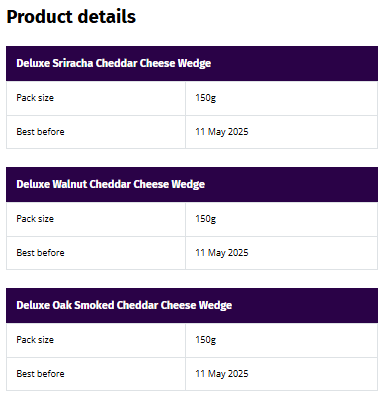
Food Alert: Lidl Northern Ireland recalls further Deluxe Cheddar Cheese Wedge products because of contamination with Listeria monocytogenes

FSA

Scientists assess relevance of second analysis for food testing

FSN

Experts in Belgium have given reasons why they believe a second analysis is not needed when doing microbiological testing.

The Scientific Committee of the Federal Agency for the Safety of the Food Chain (FASFC) proposed an amendment to the draft decree on the taking and analysis of samples in foodborne outbreaks. The advisory body provides advice on the assessment and management of risks in the food chain.

Experts said a second microbiological analysis is not scientifically relevant, given that the analysis of the first sample by an accredited laboratory provides a reliable assessment of the microbial safety of the lot.

Shigella sickens 38 people in five countries

FSN

European public health officials are monitoring an outbreak linked to international travel on long-haul flights.

A cluster of 20 genetically linked Shigella sonnei sequence type (ST) 152 cases were first reported by the United Kingdom.

Austria, France, Ireland, and the Netherlands have also recorded genetically linked cases, suggesting a common source of infection. Austria and France have seven cases each while Ireland has three and the Netherlands has one.