
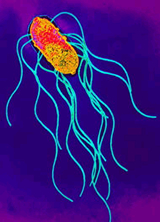
A restaurant’s faulty drainage system—thought to harbor Salmonella bacteria in biofilms—was the likely source of a long and perplexing outbreak in England, with repeated lab testing of environmental samples and comparison with clinical samples playing a key role in solving the mystery.
A research team led by Public Health England (PHE) reported its findings today in the latest edition of Eurosurveillance.
Outbreak not stopped by intensive control steps
PHE first learned of the outbreak in March 2015 when its office in East Midlands received a report from a local hospital lab about 21 patients who had been diagnosed as having Salmonella Typhimurium infections, 7 of them sick enough to be hospitalized, in the previous month.
Eventually, 82 cases among restaurant customers were linked to the outbreak, including 72 confirmed infections and 10 suspected Salmonella illnesses. Early in the outbreak, whole-genome sequencing pointed to a strong link between the cases and likely point-source contamination at the restaurant.
Interviews with patients revealed that several had eaten at the same restaurant before their symptoms began. The newly built full-service chain restaurant was popular and featured a salad bar and a self-service meat carvery buffet.
Despite several intensive steps to control the outbreak, new Salmonella infections continued to be reported until 2016.

 FoodWorld