
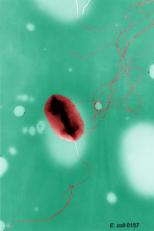
In July 2014, Public Health England (PHE) South East centre received notification of two children with Haemolytic Uraemic Syndrome (HUS) in the county of Dorset. Routine local investigations were negative for Shiga-toxin producing Escherichia coli (STEC) O157. Testing at the reference laboratory identified the causative organism as STEC O55:H7. The outbreak strain carries a sub-type verocytotoxin (VT2a) and another gene (eae) associated with elevated risk of HUS. Laboratory records showed that this strain had not previously been isolated from humans or animals in England.
By November 2015 there were 31 confirmed cases of STEC O55:H7 linked to this outbreak in the Dorset area. Twenty one cases were symptomatic with 13 developing HUS (11 children and two adults).
Detailed epidemiological, microbiological and environmental investigations were carried out, including international links to the Republic of Ireland. The only epidemiological link common to all the cases was that they either lived or had close links to Dorset County. Whole Genome Sequencing (WGS) data confirmed that all the cases were infected with the same strain. Animal and pets were also tested as part of the investigation; STEC O55:H7 was isolated from two cat faecal samples.
The outbreak was managed by an Outbreak Control Team (OCT) calling on expertise from a variety of agencies including environmental health teams; Directors of Public Health; Animal and Plant Health Agency; Food Standards Agency; Environment Agency; PHE Gastrointestinal Infections Department, PHE Gastrointestinal Bacterial Reference Unit; PHE Field Epidemiology Service; PHE Food Water and Environment laboratory and Public Health England South East Centre.
Control measures included extended screening and exclusion of cases and contacts in high risk groups. Enhanced surveillance of faecal samples in Dorset laboratories and environmental sampling occurred to help determine the extent of this organism in the community.
The outbreak was initially managed at a local level. In September 2015 additional resources and expertise were committed to this incident by PHE to explore and coordinate the wide ranging investigations that were underway. Despite this, no causal link could be made and on 16 December 2015, following a period without cases, the OCT agreed to scale back the level of involvement.

 FoodWorld