Monthly Archives: February 2017

RASFF Alert – Listeria monocytogenes -Peppered Beef Slices

kswfoodworld rasff

RASFF – Listeria monocytogenes (20 CFU/g) in chilled peppered beef slices from the United Kingdom in the UK

RASFF Alerts – Ochratoxin A – Pistchios

kswfoodworld rasff

RASFF -ochratoxin A (43 µg/kg – ppb) in pistachios from the United States in the Netherlands

RASFF Alert – E.coli -Live Clams

kswfoodworld rasff

RASFF -too high count of Escherichia coli (780 MPN/100g) in live clams (Ruditapes decussatus) from Tunisia in Italy

RASFF Alerts – Salmonella – White Sesame Seeds -Breaded Poultry – Chicken Wings – Turkey – Minced Pork and Veal -Sesame Seeds – Chicken Thigh – Chicken Breast

kswfoodworld rasff

RASFF -Salmonella enterica (presence /25g) in natural white sesame seeds from India in Cyprus

RASFF-Salmonella enterica (present /25g) in chilled breaded poultry meat preparation from Belgium in Belgium

RASFF-Salmonella enterica ser. Enteritidis (presence /25g) in frozen chicken wings from Poland in France

RASFF-Salmonella enterica ser. Heidelberg (in 4 out of 5 samples /25g) in frozen turkey half breast from Brazil in Italy

RASFF-Salmonella enterica (11:z41:e,n,z15 /25g) in peeled sesame seeds from unknown origin, via Greece in Germany

RASFF-suspicion of Salmonella enterica in chilled minced pork and veal in the Netherlands

RASFF-Salmonella enterica ser. Stanley (in 3 out of 5 samples /25g) in frozen salted chicken breasts from Thailand, via Croatia and via the Netherlands in Slovenia

RASFF-Salmonella enterica (in 2 out of 5 samples /25g) in frozen salted boneless skinless chicken breasts from Brazil in the Netherlands

RASFF-Salmonella enterica ser. Enteritidis (presence /25g) in frozen chicken drumsticks from Latvia in Estonia

RASFF Alerts – Animal Feed – Salmonella -Dog Chews -Fish Meal

kswfoodworld rasff

RASFF – Salmonella enterica ser. Typhimurium (presence /25g) in dog chew from Brazil in Germany

RASFF-Salmonella enterica (serogroups O:6,7; O:6,7; O:13,22,23 /25g) in fish meal from the United States in Germany

RASFF Alerts – Animal Feed – Enterobacteriaceae -Dog Stick Snacks

kswfoodworld rasff

RASFF– too high count of Enterobacteriaceae in dog stick snacks from China in Sweden

USA- Raw Milk -E.coli

Food Safety News

Three bills introduced into the Illinois General Assembly loosen up cottage food sales and promote farmers markets, but apparently are not intended to alter the state’s new raw milk law.

Illinois in 2016 aligned itself with the surrounding states of Iowa, Missouri and Wisconsin by prohibiting any retail sales of milk without pasteurization. On-farm sales are permitted under new regulations.

Raw milk cheese aged 60 days can be sold under a separate permit, but sales of other unpasteurized raw milk products are also prohibited.

Three bills, two in the House and one in the Senate, have been introduced in Springfield, making changes for farmers markets and cottage food producers. All three measures, with very similar language, have been assigned to committees.

Food Safety News

It is unclear whether Pride & Joy Creamery will expand its current recall of unpasteurized raw milk now that state officials have revealed additional positive test results for E. coli in the dairy’s milk.

Food Safety News

For the second time this month unpasteurized raw milk is being pulled from retail dairy cases in Washington because of E. coli contamination. This time it’s Cozy Vale Creamery of Tenino, WA.

The Washington State Department of Agriculture inspectors discovered the contamination in a sample of the dairy’s raw milk and is working with the dairy owners to determine the source of the Shiga toxin-producing E. coli, according to the recall notice.

USA -Ready Pac Foods Inc. Recalls Chicken Salad Products Due to Possible Listeria Contamination

FSIS – USDA

WASHINGTON, Feb. 22, 2017 – Three Ready Pac Foods Inc. establishments, located in Swedesboro, N.J., in Jackson, Ga., and the headquarters establishment in Irwindale, Calif., are recalling approximately 59,225 pounds of one variety of chicken salad product that may be adulterated withListeria monocytogenes, the U.S. Department of Agriculture’s Food Safety and Inspection Service (FSIS) announced today.

The Puro Picante Blazin’ Hot salad items were produced between Jan. 17, 2017 and Feb. 17, 2017. The following products are subject to recall: [View Labels(PDF only)]

  • 7.5-oz. single serve salad bowl packages of “Ready Pac Foods Puro Picante Blazin Hot” with Use By Dates of 01/31/17 through 03/04/2017.

The products subject to recall bear establishment number P-27497, P-32081, or P-18502B inside the USDA mark of inspection. These items were shipped to retail locations nationwide.

The problem was discovered on Feb. 21, 2017 when the firm received notification from the cheese supplier that the cheese ingredient utilized in the chicken salad products was included in an expanded cheese recall due to potential contamination with L. monocytogenes. There have been no confirmed reports of adverse reactions due to consumption of these products.

Consumption of food contaminated with L. monocytogenes can cause listeriosis, a serious infection that primarily affects older adults, persons with weakened immune systems, and pregnant women and their newborns. Less commonly, persons outside these risk groups are affected.

Listeriosis can cause fever, muscle aches, headache, stiff neck, confusion, loss of balance and convulsions sometimes preceded by diarrhea or other gastrointestinal symptoms. An invasive infection spreads beyond the gastrointestinal tract. In pregnant women, the infection can cause miscarriages, stillbirths, premature delivery or life-threatening infection of the newborn. In addition, serious and sometimes fatal infections can occur in older adults and persons with weakened immune systems. Listeriosis is treated with antibiotics. Persons in the higher-risk categories who experience flu-like symptoms within two months after eating contaminated food should seek medical care and tell the health care provider about eating the contaminated food.

FSIS and the company are concerned that some of this recalled product may be in consumers’ refrigerators.

Consumers who have purchased these products are urged not to consume them. These products should be thrown away or returned to the place of purchase.

FSIS routinely conducts recall effectiveness checks to verify recalling firms notify their customers of the recall and that steps are taken to make certain that the product is no longer available to consumers. When available, the retail distribution list(s) will be posted on the FSIS website at www.fsis.usda.gov/recalls.

Consumers with questions regarding the recall can contact Mary Toscano, Corporate Affairs Supervisor, at 1-800-800-7822. Media with questions regarding the recall can contact Alan Hilowitz, Director of Corporate Communications, at (626) 678-2180.

Consumers with food safety questions can “Ask Karen,” the FSIS virtual representative available 24 hours a day at AskKaren.gov or via smartphone at m.askkaren.gov. The toll-free USDA Meat and Poultry Hotline 1-888-MPHotline (1-888-674-6854) is available in English and Spanish and can be reached from 10 a.m. to 4 p.m. (Eastern Time) Monday through Friday. Recorded food safety messages are available 24 hours a day. The online Electronic Consumer Complaint Monitoring System can be accessed 24 hours a day at: https://www.fsis.usda.gov/reportproblem.


Research -Finds Salmonella Food Poisoning Could Damage DNA

SalmonellaFood Poisoning Bulletin

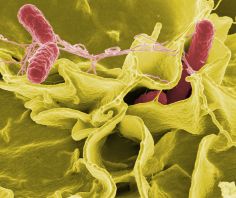
Research at Cornell University has found that Salmonella food poisoning caused by some serotypes of the pathogenic bacteria could permanently damage your DNA. The study is published in the journal mBio by the American Society for Microbiology as “The Cytolethal Distending Toxin Produced by Nontyphoidal Salmonella Serotypes Javiana, Montevideo, Oranienburg, and Mississippi Induces DNA Damage in a Manner Similar to That of Serotype Typhi.” Dr. Rachel Miller, author of the study, said, “not all Salmonella serotypes are equal.”

Europe -Antimicrobial Resistance

Europa

Antimicrobial Resistance (AMR) is the ability of microorganisms to resist antimicrobial treatments, especially antibiotics. AMR not only has a direct impact on human and animal health – due to the failure in the treatment of infectious diseases – but also carries a heavy economic cost.

AMR is a natural phenomenon but an accumulation of factors, including excessive and inappropriate use of antimicrobial medicines on humans and animals and poor infection control practices, transformed AMR into a serious threat to public health worldwide.

This leads to:

  • increasing healthcare costs
  • prolonged hospital stays
  • treatment failures
  • a significant number of deaths

Global consumption of antibiotics in human medicine rose by nearly 40% between 2000 and 2010 (UK Report).

In the US alone, “more than two million people are sickened every year with antibiotic-resistant infections, with at least 23.000 dying as a result” (data from the Centers for Disease Control and Prevention, 2009-2011).

In the EU, 25.000 people die each year from an infection due to antibiotic-resistant bacteriapdf(data from 2007). Infections due to these selected multidrug-resistant bacteria in the EU result in extra healthcare costs and productivity losses of at least €1.5 billion each year. If the current trend is not altered, 300 million people worldwide are expected to die prematurely because of drug resistance over the next 35 yearspdf.

AMR spreads through global tourism, transfer of patients between healthcare facilities within and from outside the EU, and through trade in food and animals.

It is an important global economic and a societal challenge that can’t be tackled by countries or public administrations alone. Therefore, the problem needs a comprehensive One Healthapproach to it. That means that a holistic, multi-sectorial approach, involving many different sectors (public health, food safety, bio-safety, environment, research and innovation, international cooperation, animal health and welfare as well as non-therapeutic use of antimicrobial substances) is needed to tackle this complex problem.

In June 2016, the Commission published the Eurobarometer results on Antimicrobial Resistance awarenesspdf(3 MB) Choose translations of the previous link . The main conclusion of this Eurobarometer was that knowledge across the EU remains low.

The report, published on 16 June 2016, shows a 6% decrease in consumption in the last years even though some countries are still showing an increase in their consumption.

For more information, please refer to:

A Flash Eurobarometer in non-EU countries was also published in November 2016.

For more background information regarding AMR, please refer to the following factsheet: AMR: A major European and Global challenge.pdf(358 kB)