
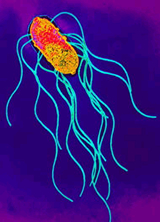
Technological advances are making the analysis of single bacterial infected human cells feasible, Würzburg researchers have used this technology to provide new insight into the Salmonella infection process. The study has just been published in “Nature Microbiology”.
Infectious diseases are a leading cause of mortality worldwide. The development of novel therapies or vaccines requires improved understanding of how viruses, pathogenic fungi or bacteria cause illnesses.
Some bacterial pathogens such as Salmonella invade and replicate within human cells. Science is steadily shifting its focus towards studying infected cells and how differences between individual host cells affect the cellular response to pathogens.
A research team headed by Professor Jörg Vogel from the University of Würzburg has made significant progress in this area. They have developed a novel technique that allows them to investigate the interplay of individual host cells with infecting bacteria. This study is based on close collaboration between Jörg Vogel’s team at the Institute of Molecular Infection Biology, the core unit Systems Medicine of the Medical Faculty and researchers at Imperial College in London. Their results have now been published in the scientific journal “Nature Microbiology”.

 FoodWorld