
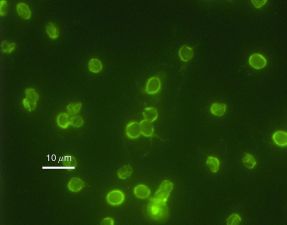
Cryptosporidiosis can vary quite substantially in annual occurrence and causation. Between 2005 and 2014 cases recorded annually ranged from 3099 to 6013 (mean 4147)* with many outbreaks linked to drinking water, swimming pools, person-to-person spread, animal contact, and food.
Cases in 2015 were much increased over most previous years (the exceptions being 2009 and 2012). In September 2015 there was an increase in cryptosporidiosis across England, Wales and Scotland that peaked in week 38 and was investigated using specialist testing and descriptive epidemiology, and a hypothesis-generating trawling questionnaire. Typing at the Cryptosporidium Reference Unit (CRU) and Scottish Parasite Diagnostic and Reference Laboratory (SPDRL) showed the predominant species to be Cryptosporidium hominis GP60 subtype IbA10G2 and infections were found in both children and adults. No common activity or exposure was identified in patients who were interviewed. While the increase coincided with a rise in cases linked to travel to Spain, there was no analytical evidence that this was the cause of the increase.
In November 2015 cryptosporidiosis cases again began to increase across England, Wales and Scotland, peaking in week 47, and cases were again investigated using descriptive epidemiology and specialist testing. The CRU and SPDRL identified that the outbreak was caused by Cryptosporidium parvum GP60 subtype IIdA24G1 and was predominantly in adults. A hypothesis-generating trawling questionnaire identified a number of potential risk factors and these are being used to conduct a case-control study across England, Wales and Scotland aimed at identifying the source, vehicle and route of transmission in this outbreak.
Cryptosporidium is a particular problem because of the resistance of its oocysts to chlorine. Outbreaks linked to drinking water, which were of regular occurrence in the 1990s, have declined since the turn of the century as a result of improvements in mains water treatment and are now uncommon in the UK. A large outbreak in May 2012 was traced to bagged salad (see Current note 47/1302 at http://www.hps.scot.nhs.uk/ewr/redirect.aspx?id=54463), suggesting that nationally distributed foods may be a less well recognised source of infection. Swimming pool outbreaks remain an important and regular occurrence, particularly in the second half of the year. Travel-related disease can also be important, but can be rather difficult to investigate. The C. parvum outbreak is over, but cases of C. hominis remain above what has been normally seen in previous years. [Source – Text adapted from Health Protection Report, 22 January 2016. https://www.gov.uk/government/publications/health-protection-report-volume-…]
*Figures quoted here are for England and Wales.

 FoodWorld