
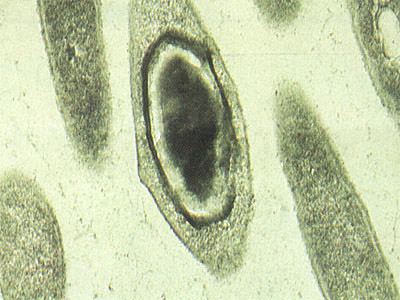
Some bacteria can form spores (survival capsules) that are particularly resistant to heat. Since sporogenous bacteria can also cause food poisoning and a reduction in food quality, they constitute a significant threat to the food industry.
If spores are to pose a risk, they have to “wake up” from a state of hibernation and return to their normal growth cycle through a process called germination.
Refrigerated foods with a shelf-life of several weeks are often heat-processed at temperatures between 65 – 95 C. This kills the majority of bacteria, but Bacillus spores can survive, germinate and develop into growing bacteria. Thermal treatment of this kind will in fact improve the growth potential of sporogenous bacteria because the heat kills competing bacteria flora and stimulates the surviving spores so that germination can commence more rapidly. The thermal treatment can increase the risk of spore germination in food and result in subsequent bacterial growth and a risk of quality deterioration and food poisoning.
Løvdal has investigated how the germination characteristics of the spores of four different Bacillus species are affected by heat treatment. She has used knowledge about the spores’ response to temperature to experiment with a method which can reduce the spore level without increasing the overall thermal treatment of the food product.

 FoodWorld